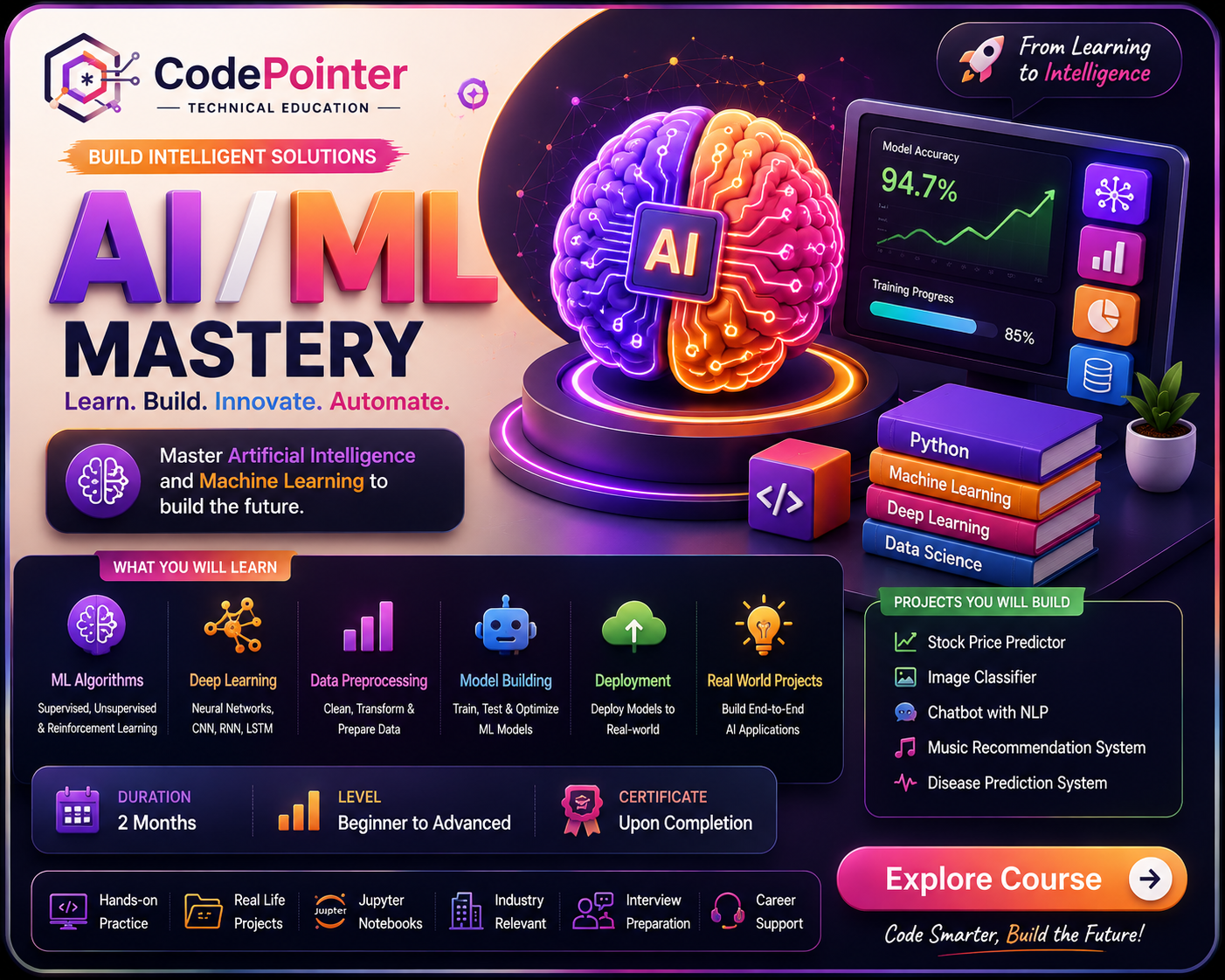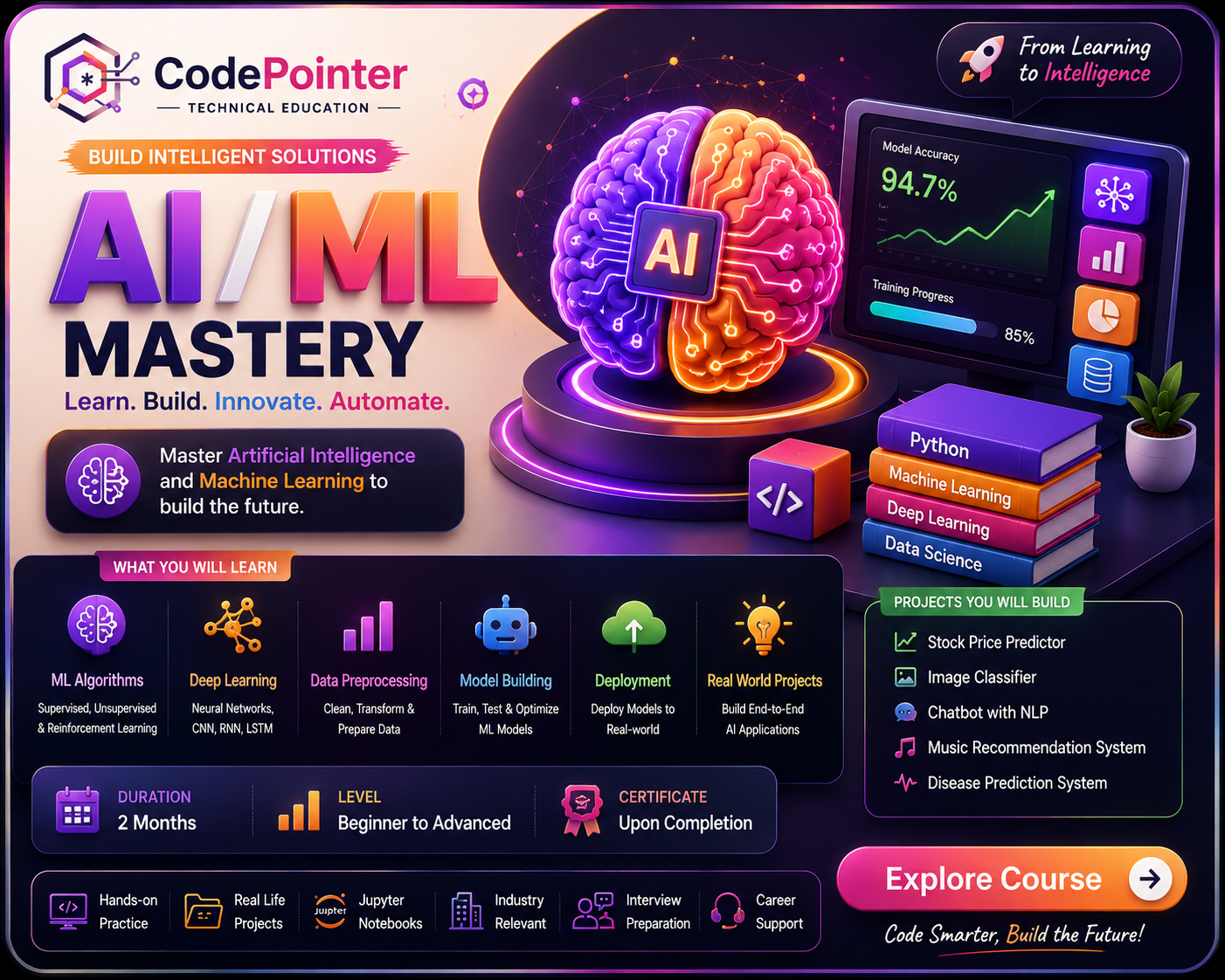
AI/ML
From Data to Intelligence — Build Intelligent Real-World Applications
---
WHY DID CODEPOINTER DESIGN THIS COURSE?
Before designing our AI/ML program, the CodePointer team conducted a detailed market survey to understand the current requirements of the IT industry and the rapidly growing demand for Artificial Intelligence and Machine Learning skills.
We studied:
What AI/ML technologies companies are using
What skills are expected from freshers and aspiring AI/ML professionals
Which programming languages and libraries are relevant
How Machine Learning is used in real-world applications
What practical skills employers look for
How AI is changing software development and business processes
The gap between academic AI/ML knowledge and industry-level implementation
The result was clear:
> Companies don't just need people who know AI/ML terminology. They need professionals who can work with data, build models, evaluate results and develop practical intelligent solutions.
That is why CodePointer designed an industry-oriented AI/ML program that takes learners from Python and data fundamentals to Machine Learning, Deep Learning and real-world AI applications.
---
WHAT IS ARTIFICIAL INTELLIGENCE & MACHINE LEARNING?
Artificial Intelligence is the broader concept of creating systems that can perform tasks that normally require human intelligence.
These tasks can include:
Understanding information
Making predictions
Recognizing patterns
Understanding language
Identifying images
Making recommendations
Automating decisions
Machine Learning is a major part of AI where computers learn patterns from data and use those patterns to make predictions or decisions.
In simple words:
DATA → PREPROCESSING → MODEL → TRAINING → EVALUATION → PREDICTION
Instead of manually programming every possible situation, Machine Learning allows systems to learn from examples.
---
WHY IS AI/ML IMPORTANT?
AI is no longer limited to research laboratories.
Today, intelligent technologies are being used in:
Banking
Healthcare
E-commerce
Education
Finance
Cybersecurity
Manufacturing
Marketing
Transportation
Software development
Customer support
Examples include:
Recommendation Systems
Suggest products, movies or content based on user behaviour.
Fraud Detection
Identify unusual financial transactions.
Chatbots
Understand questions and provide automated responses.
Image Recognition
Identify objects, faces or patterns in images.
Predictive Analytics
Use historical data to predict future outcomes.
Natural Language Processing
Allow computers to work with human language.
The demand for intelligent and data-driven applications is making AI/ML an increasingly important technical skill.
---
THE MARKET NEED
Modern organizations generate enormous amounts of data.
But:
Data alone has no value if an organization cannot understand it and use it for decision-making.
Companies need professionals who can:
Collect → Clean → Analyze → Learn → Predict → Automate
This creates opportunities across roles such as:
Machine Learning Engineer
AI Engineer
Data Scientist
AI/ML Developer
Python Developer
Data Analyst
Computer Vision Engineer
NLP Engineer
Our objective at CodePointer is to help learners develop the technical foundation required to enter this ecosystem.
---
PYTHON FOR AI/ML
Build Your AI Foundation
Python is one of the most important programming languages for modern AI and Machine Learning.
It provides a powerful ecosystem of libraries and frameworks used for:
Data analysis
Data preprocessing
Machine Learning
Deep Learning
Visualization
Automation
AI application development
Students first develop strong Python fundamentals before moving into advanced AI/ML concepts.
Python Fundamentals
Variables
Data Types
Operators
Conditions
Loops
Functions
Lists & Tuples
Dictionaries & Sets
File Handling
Exception Handling
Object-Oriented Programming
Modules & Packages
The objective is not simply to learn Python syntax.
The objective is to use Python as a tool for solving real problems.
---
NUMPY
Work With Numerical Data
NumPy provides powerful tools for numerical computing in Python.
Students learn:
Arrays
Multi-dimensional arrays
Array operations
Mathematical operations
Indexing & slicing
Statistical operations
Data manipulation
NumPy forms an important foundation for working with numerical datasets and Machine Learning workflows.
---
PANDAS
Turn Raw Data Into Useful Data
Before training a Machine Learning model, data needs to be understood and prepared.
Pandas helps developers and analysts work with structured datasets.
Students learn:
DataFrames
Series
Reading datasets
Data cleaning
Missing values
Filtering
Sorting
Grouping
Merging datasets
Data transformation
The workflow becomes:
Raw Data → Clean Data → Useful Data → Machine Learning
---
DATA PREPROCESSING
Good Models Need Good Data
Machine Learning models depend heavily on the quality of the data they receive.
Students learn how to handle:
Missing values
Duplicate records
Incorrect data
Outliers
Categorical data
Numerical features
Feature scaling
Data transformation
Training & testing datasets
This helps learners understand an important industry concept:
> A Machine Learning model is only as useful as the data and methodology behind it.
---
DATA VISUALIZATION
Before building a model, we need to understand the data.
Students work with visualization techniques using tools such as:
Matplotlib
Seaborn
They learn to identify:
Trends
Patterns
Relationships
Distributions
Outliers
Correlations
Visualization helps answer:
What is actually happening inside our data?
---
MACHINE LEARNING
Teach Machines to Learn From Data
This is the core of the program.
Students understand the complete Machine Learning lifecycle:
Problem Definition
↓
Data Collection
↓
Data Cleaning
↓
Feature Engineering
↓
Model Selection
↓
Model Training
↓
Model Evaluation
↓
Prediction
↓
Deployment
---
SUPERVISED LEARNING
In supervised learning, the model learns from data where the expected output is already known.
Students explore:
Regression
Used when the output is a numerical value.
Examples:
House Price Prediction
Salary Prediction
Sales Forecasting
Demand Prediction
Classification
Used when the output belongs to a category.
Examples:
Spam Detection
Customer Churn
Fraud Detection
Disease Prediction
Loan Approval
---
UNSUPERVISED LEARNING
In unsupervised learning, the system looks for patterns in data without predefined output labels.
Students explore:
Clustering
Grouping similar data points together.
Examples:
Customer Segmentation
Product Grouping
Behaviour Analysis
This helps learners understand how AI can discover hidden patterns within datasets.
---
MACHINE LEARNING ALGORITHMS
Students gain practical exposure to important Machine Learning concepts and algorithms, including:
Linear Regression
Logistic Regression
Decision Trees
Random Forest
K-Nearest Neighbors
Support Vector Machines
Naive Bayes
K-Means Clustering
The focus is on understanding:
What is the algorithm?
When should we use it?
How does it work?
How do we evaluate it?
---
MODEL EVALUATION
Building a model is only the beginning.
A model needs to be tested to understand how well it performs.
Students learn concepts such as:
Accuracy
Precision
Recall
F1 Score
Confusion Matrix
Mean Absolute Error
Mean Squared Error
Cross Validation
The goal is to understand whether a model is actually solving the problem effectively.
---
FEATURE ENGINEERING
Give the Model Better Information
Features are the inputs that a Machine Learning model uses to learn.
Students learn how to:
Select useful features
Transform features
Create new features
Remove unnecessary information
Encode categorical values
Scale numerical data
Feature engineering is an important practical skill because real-world datasets are rarely ready for direct model training.
---
DEEP LEARNING
Move Beyond Traditional Machine Learning
Deep Learning uses neural networks to learn complex patterns from large amounts of data.
Students are introduced to:
Neural Networks
Neurons
Layers
Activation Functions
Forward Propagation
Backpropagation
Training
Loss Functions
Optimizers
This creates a foundation for advanced AI applications.
---
COMPUTER VISION
Teach Machines to Understand Images
Computer Vision allows machines to process and understand visual information.
Students explore concepts such as:
Image Processing
Image Classification
Object Recognition
Computer Vision Basics
Image-based Machine Learning
Possible applications include:
Face Recognition
Object Detection
Image Classification
Quality Inspection
---
NATURAL LANGUAGE PROCESSING
Teach Machines to Understand Human Language
NLP focuses on enabling computers to work with text and human language.
Students explore:
Text Processing
Tokenization
Text Classification
Sentiment Analysis
Basic Chatbot Concepts
Natural Language Understanding
Possible applications include:
Customer Support
Chatbots
Sentiment Analysis
Text Classification
Automated Responses
---
AI/ML PROJECTS
Theory becomes valuable when learners can use it to build something.
Students can work on practical projects such as:
House Price Prediction
Build a model that predicts property prices using historical data.
Customer Churn Prediction
Predict whether a customer is likely to leave a service.
Spam Email Detection
Classify messages as spam or legitimate.
Recommendation System
Recommend relevant products or content.
Student Performance Prediction
Analyze student data and predict performance patterns.
Image Classification
Train a model to identify different categories of images.
AI Chatbot
Build a basic intelligent conversational application.
Disease Prediction
Use appropriate datasets to develop a predictive classification model.
---
THE COMPLETE CODEPOINTER AI/ML STACK
PROGRAMMING
Python
↓
DATA & COMPUTING
NumPy • Pandas
↓
VISUALIZATION
Matplotlib • Seaborn
↓
MACHINE LEARNING
Scikit-learn • Regression • Classification • Clustering
↓
DEEP LEARNING
Neural Networks • Deep Learning Fundamentals
↓
AI APPLICATIONS
NLP • Computer Vision • Recommendation Systems
↓
PROJECTS
Real-World AI/ML Applications
---
HOW A REAL AI/ML PROJECT WORKS
Imagine a company wants to predict customer churn.
STEP 1 — COLLECT DATA
Customer information is collected.
↓
STEP 2 — CLEAN DATA
Missing and incorrect values are handled.
↓
STEP 3 — ANALYZE DATA
Patterns and relationships are identified.
↓
STEP 4 — PREPARE FEATURES
Important information is selected and transformed.
↓
STEP 5 — TRAIN MODEL
A Machine Learning algorithm learns from historical data.
↓
STEP 6 — EVALUATE
The model is tested using appropriate evaluation metrics.
↓
STEP 7 — PREDICT
The model predicts whether a customer may leave.
↓
STEP 8 — APPLICATION
The prediction can help the business take action.
This is how AI/ML moves from data to decision-making.
---
WHY LEARN AI + ML TOGETHER?
AI is a broad field.
Machine Learning is one of the major technologies that makes intelligent systems possible.
Learning them together helps students understand:
Programming → Data → Machine Learning → Deep Learning → Intelligent Applications
Instead of simply learning algorithms, students understand the complete AI/ML development process.
---
FROM STUDENT TO AI/ML PROFESSIONAL
At CodePointer, our goal is to move learners beyond simply watching tutorials or memorizing algorithms.
We want learners to develop the ability to:
Understand → Analyze → Code → Train → Evaluate → Improve → Build
A learner should be able to look at an AI/ML problem and ask:
What is the problem?
What data do we need?
How should the data be cleaned?
Which features are important?
Which algorithm should we choose?
How do we measure performance?
How can we improve the model?
How can the solution be used in a real application?
That is the mindset required for practical AI/ML development.
---
WHY CODEPOINTER?
We don't design our programs simply by following a textbook.
We begin by understanding:
MARKET REQUIREMENTS
↓
INDUSTRY TECHNOLOGIES
↓
PRACTICAL SKILLS
↓
PROJECT-BASED LEARNING
↓
CAREER READINESS
Our objective is to reduce the gap between:
COLLEGE KNOWLEDGE
and
INDUSTRY EXPECTATIONS
We are also working towards building relationships with companies that can participate in the placement ecosystem and provide opportunities to suitable, job-ready candidates.
---
YOUR AI/ML JOURNEY STARTS HERE
Don't just learn what Artificial Intelligence means.
Learn how intelligent systems are actually built.
Python • NumPy • Pandas
Matplotlib • Seaborn
Machine Learning • Deep Learning
NLP • Computer Vision
Model Training • Model Evaluation
Real-World AI/ML Projects
---
CODEPOINTER
LEARN THE TECHNOLOGY.
UNDERSTAND THE DATA.
BUILD INTELLIGENT SOLUTIONS.
GET INDUSTRY READY.
Enroll Now