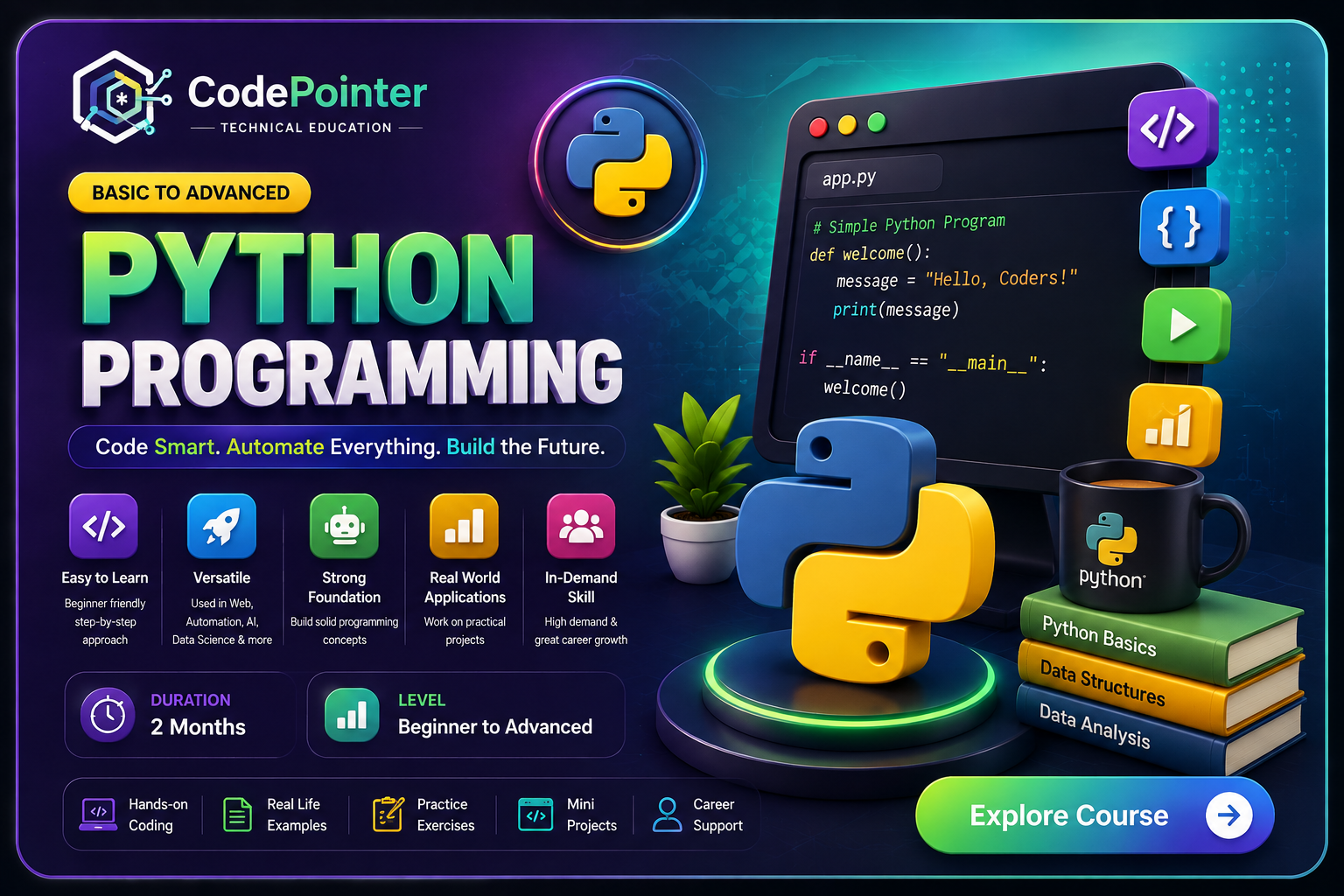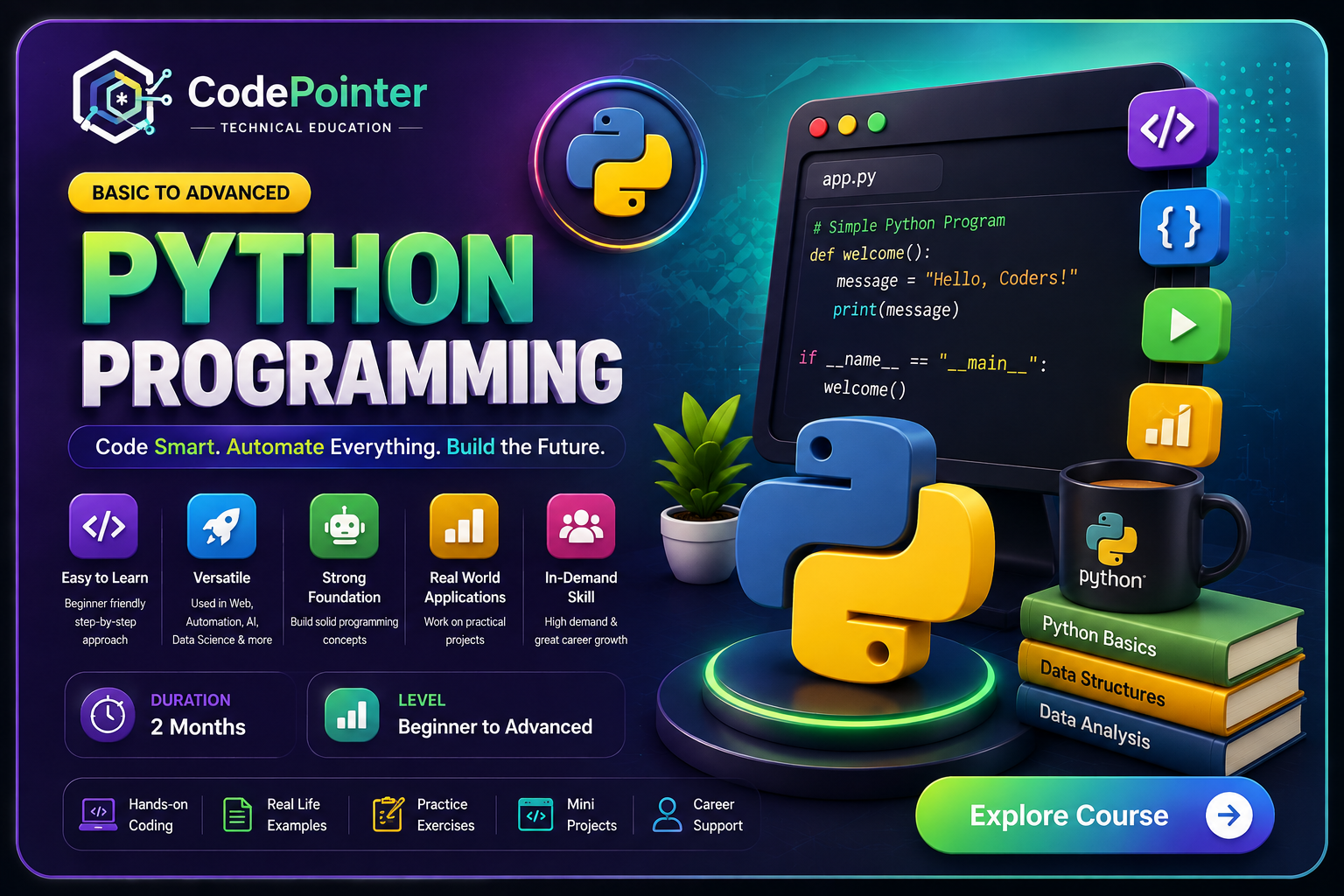
PYTHON PROGRAMMING
Why Python Is One of the Most Valuable Programming Skills Today?
Python has become one of the most widely used programming languages across technology, software development, automation, data, AI and many other areas.
But at CodePointer, we don't teach Python simply because it is popular.
We teach Python to help students learn how to think, solve problems and build real applications.
Python has a simple and readable syntax, which makes it easier for beginners to start programming while still being powerful enough to build practical and professional applications.
Our focus is not:
Learn Python → Remember Syntax → Finish the Course
Our focus is:
Understand → Think → Build → Debug → Improve
PYTHON IS EASY TO LEARN. BUT LEARNING TO THINK IS THE REAL SKILL.
Many students can learn Python syntax quickly.
They can write:
-
Variables
-
Conditions
-
Loops
-
Functions
But the real challenge comes when they are given a problem and asked:
"Now solve this."
This is where logic building becomes important.
At CodePointer, we focus strongly on helping students develop the ability to understand a problem and create their own solution.
We don't want students to memorize programs.
We want them to understand how programs are created.
LOGIC BUILDING WITH PYTHON
Programming is not about writing code as quickly as possible.
It is about understanding the problem before writing the code.
At CodePointer, we encourage students to follow an approach such as:
Understand the Problem
↓
Break the Problem Into Smaller Parts
↓
Think About the Solution
↓
Build the Logic
↓
Write the Python Code
↓
Test the Solution
↓
Find & Fix Errors
↓
Improve the Solution
This approach helps students develop programming confidence and independent problem-solving ability.
PRACTICAL PYTHON LEARNING
At CodePointer, students don't just watch an instructor write code.
They write code themselves.
They experiment.
They make mistakes.
They debug.
They try different approaches.
They improve their solutions.
Because programming is a skill that develops through practice.
Our objective is to make students comfortable with solving problems rather than making them dependent on ready-made code.
PYTHON + SQL
Learn Python With Real Data
Real-world applications need data.
Whether it is:
-
Student information
-
Employee records
-
Customer details
-
Products
-
Orders
-
Transactions
-
Registration data
-
Reports
Applications need a way to store and manage this information.
That's why at CodePointer, we connect Python with SQL and databases through practical application development.
Students understand how Python can communicate with a database and work with real application data.
Python handles the application logic.
SQL handles the data.
Together, they create the foundation for database-driven applications.
BUILD REAL APPLICATIONS WITH PYTHON
Imagine a Student Management System.
A user enters student information.
The Python application processes the information.
The application communicates with the database.
SQL stores the information.
Later, the application can retrieve, update, search or delete that information.
This creates a complete flow:
User → Python Application → SQL → Database → Python Application → User
At CodePointer, we focus on helping students understand this complete flow rather than learning technologies in isolation.
PYTHON GUI DEVELOPMENT
Don't Just Write Programs. Build Applications.
Python can also be used to create Graphical User Interface (GUI) applications.
At CodePointer, students get practical exposure to building GUI-based applications where users can interact with the software through:
Windows
Buttons
Input Fields
Forms
Menus
Tables
Messages
Instead of interacting with only a command-line program, students can understand how programming logic can be converted into a user-friendly application.
This makes programming more visual, practical and engaging.
PYTHON GUI + SQL
The real learning becomes more interesting when Python GUI and SQL are combined.
For example, students can build an application where:
User enters information
↓
GUI collects the input
↓
Python processes the data
↓
SQL stores it in the database
↓
Python retrieves the information
↓
GUI displays the result
This gives students an understanding of how a complete desktop application can work.
From writing code to building software.
PROJECT-BASED LEARNING
At CodePointer, projects are not treated simply as something to complete at the end.
Projects are used as a way to bring programming concepts together.
Students can work on practical applications such as:
-
Student Management System
-
Employee Management System
-
Library Management System
-
Billing Application
-
Inventory Management System
-
Registration System
-
Record Management Application
-
Desktop Utility Applications
The purpose is not just to create a project.
The purpose is to understand how the project works internally.
DOUBT SESSIONS
Learning programming naturally comes with doubts.
Sometimes the logic is confusing.
Sometimes the code gives an unexpected output.
Sometimes the database connection doesn't work.
Sometimes the application works but the data is not being stored correctly.
At CodePointer, students get doubt-solving support to help them understand the actual reason behind the problem.
We don't believe in simply giving the correct code.
We focus on helping students understand:
What went wrong?
Why did it happen?
How can it be fixed?
How can you solve a similar problem yourself?
Clearing a doubt is good.
Learning how to solve the next doubt independently is better.
ONE-TO-ONE MENTORSHIP
Every student has a different learning speed and different challenges.
That's why CodePointer provides one-to-one mentorship to help students discuss their individual learning and technical problems.
Students can seek guidance related to:
-
Programming logic
-
Coding problems
-
Projects
-
Database-related issues
-
Application development
-
Learning direction
-
Technical growth
Personal Attention.
Individual Guidance.
Better Learning Direction.
CODEPOINTER MEETUPS
Learning technology is not limited to classrooms.
Through CodePointer Meetups, students get opportunities to interact with other learners, discuss programming, share ideas and learn from the community.
Meetups can help students:
-
Discuss coding problems
-
Share project ideas
-
Explore technologies
-
Talk about development
-
Learn different approaches
-
Ask questions
-
Improve communication
-
Build professional connections
Learn. Discuss. Build. Grow.
DEBUGGING — A DEVELOPER'S MINDSET
Errors are a normal part of programming.
A good developer doesn't get frustrated every time an error appears.
They investigate it.
At CodePointer, students are encouraged to develop a systematic debugging approach:
Read the Error
↓
Understand the Problem
↓
Find the Source
↓
Check the Logic
↓
Fix the Issue
↓
Test Again
This helps students develop patience, analytical thinking and confidence while working with real applications.
DON'T JUST COPY PYTHON CODE.
UNDERSTAND WHY IT WORKS.
Copying code can make a program work.
Understanding the code can make you better.
At CodePointer, students are encouraged to ask:
Why are we using this approach?
Can we solve it differently?
What happens if the input changes?
Can the code be improved?
How does the database interact with the application?
Our goal is to develop independent programmers.
FROM PYTHON PROGRAMMER TO APPLICATION BUILDER
Python can take students far beyond basic programming.
With the right foundation, students can explore different areas of technology and development.
But regardless of the direction they choose, we believe the foundation should remain strong:
Programming Logic
Problem Solving
Practical Coding
Database Understanding
Application Development
Debugging
Independent Thinking
That's what we focus on at CodePointer.
INDUSTRY-ORIENTED LEARNING
The technology industry continues to evolve.
New frameworks, tools and technologies are introduced regularly.
But strong programming fundamentals remain valuable.
At CodePointer, we focus on helping students develop skills that can support them as they move toward different technology domains.
We focus on the ability to:
Understand a Problem
Create a Solution
Write Code
Work With Data
Build Applications
Debug Errors
Improve Solutions
Explain What You Built
MORE THAN A PYTHON CLASS
At CodePointer, Python learning is supported through a practical learning environment that includes:
Logic Building
Learn how to approach programming problems.
Practical Coding
Write and implement instead of only watching.
Python + SQL
Understand how applications work with real data.
GUI Development
Learn how programming logic can become interactive applications.
Projects
Bring different concepts together to build practical applications.
Doubt Sessions
Get help when you are stuck.
One-to-One Mentorship
Receive individual technical guidance.
Meetups
Learn, interact and grow with a programming community.
OUR GOAL
We don't want students to finish Python saying:
"I have completed Python."
We want them to be able to say:
"I can understand a problem, build the logic, write the code, work with data and create an application."
That's the difference between learning a programming language and developing a programming skill.
CODEPOINTER
Learn Python. Build Logic. Create Applications.
Think Before You Code.
Build With Python.
Work With SQL.
Create GUI Applications.
Solve Real Problems.
Learn With Mentorship.
Grow With the Community.
CodePointer — Where Programming Starts With Logic.
Enroll Now