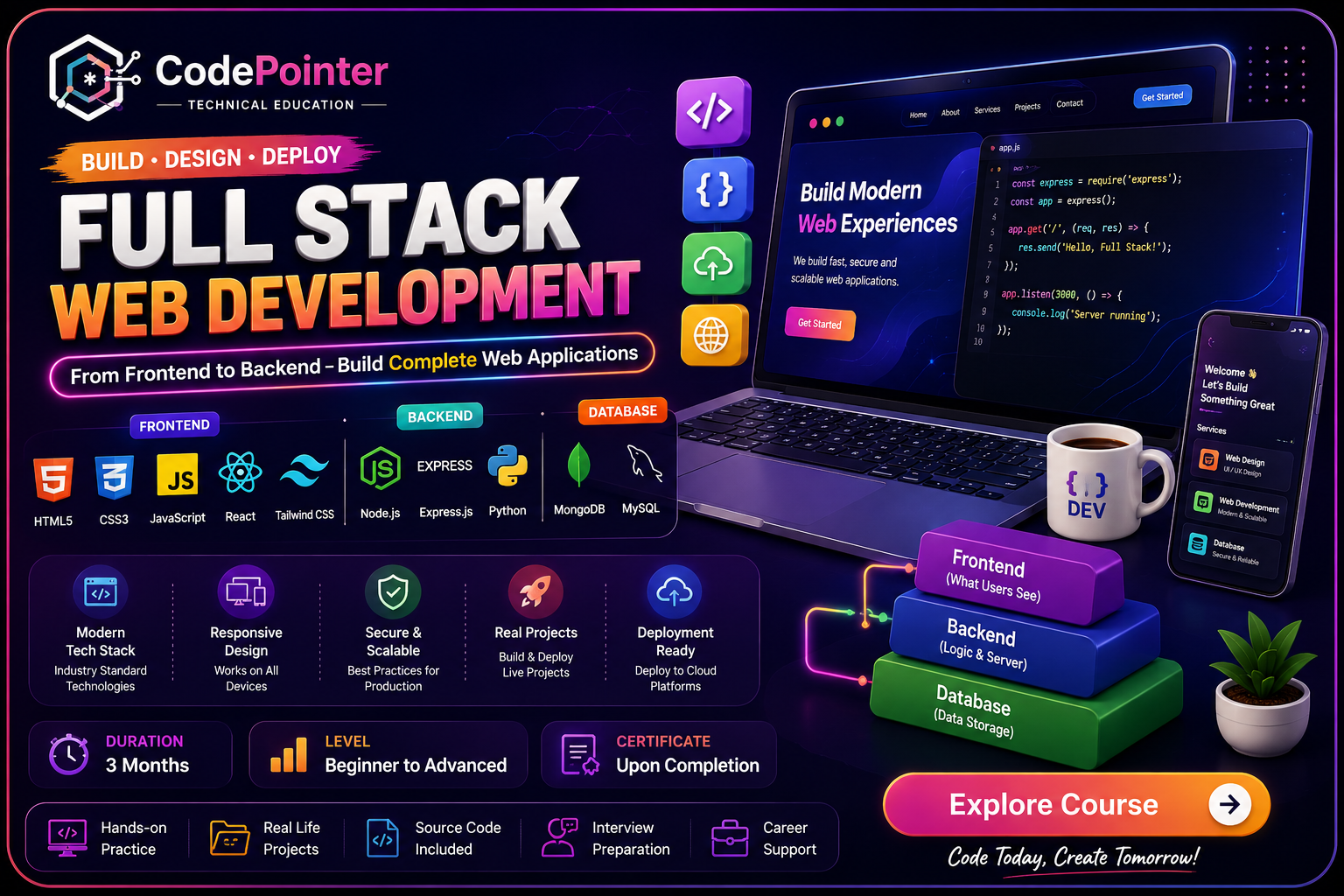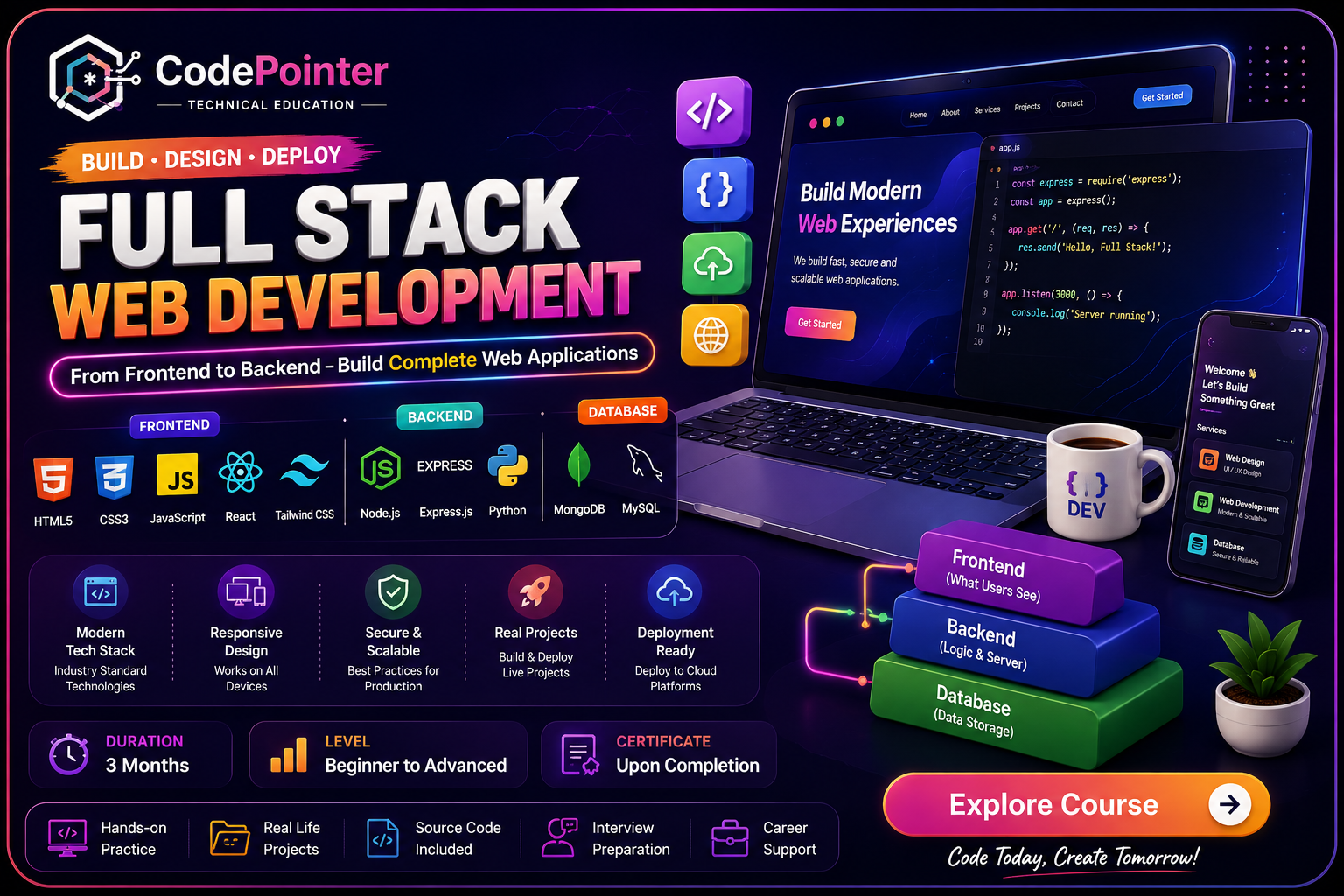
FULL STACK WEB DEVELOPMENT
From Frontend to Backend — Build Complete Web Applications
Why Did CodePointer Design This Course?
Before designing our Full Stack Web Development program, the CodePointer team conducted a detailed market survey to understand the current requirements of the IT industry.
We studied:
- What technologies companies are actually using
- What skills are expected from freshers and developers
- Which frontend and backend technologies are relevant in modern web development
- How real-world websites and web applications are developed
- What technical skills help students become more industry-ready
- The gap between academic knowledge and practical development skills
The result was clear:
«Companies don't just need people who can write code. They need developers who can understand and build a complete application.»
That is the reason CodePointer designed a Full Stack Web Development program covering the complete development journey—from the interface users see to the backend logic and databases working behind it.
---
WHAT IS FULL STACK WEB DEVELOPMENT?
A website is not just a beautiful webpage.
When you log in, register, place an order, make a payment, upload a document, search for something, or receive personalized information, a lot of technology is working behind the scenes.
A Full Stack Developer understands and works across the major layers of a web application:
FRONTEND
What the user sees and interacts with.
↓
BACKEND
The logic and services working behind the application.
↓
DATABASE
Where application information is stored, managed, and retrieved.
In simple words:
User Interface → Backend Logic → Database → Response → User Interface
A Full Stack Developer learns how these different layers communicate with each other to create a complete working application.
---
WHY IS FULL STACK DEVELOPMENT IMPORTANT?
The modern web development industry is no longer limited to creating static webpages.
Businesses need:
- Dynamic websites
- E-commerce platforms
- Student portals
- Banking applications
- Management systems
- Booking platforms
- Authentication systems
- Business dashboards
- REST APIs
- Data-driven applications
- Scalable web applications
All these applications require multiple technologies working together.
That's why understanding the complete development stack gives a developer a much broader technical perspective.
---
THE MARKET NEED
Modern organizations are increasingly building applications that connect user interfaces, APIs, business logic, databases, and external services.
Current developer ecosystem data reflects the importance of several technologies used in our approach. In Stack Overflow's 2025 Developer Survey, JavaScript was used by 66% of respondents, HTML/CSS by about 62%, and SQL by about 59%. Python also recorded a substantial year-over-year increase in adoption.
This tells us something important:
Learning one technology is not enough.
A developer should understand how technologies work together.
That's the mindset behind the CodePointer Full Stack program.
---
FRONTEND DEVELOPMENT
Build What the User Sees
Frontend is the visible part of a website or web application.
It includes everything the user interacts with:
Buttons • Forms • Menus • Cards • Tables • Animations • Dashboards • Responsive Layouts
Our frontend technology stack focuses on:
HTML
HTML provides the structure of a webpage.
It helps create:
- Headings
- Paragraphs
- Forms
- Tables
- Images
- Links
- Buttons
- Page sections
CSS
CSS controls the look and design of the application.
It is used for:
- Colors
- Layouts
- Spacing
- Typography
- Responsive design
- Animations
- Components
- Visual effects
JavaScript
JavaScript adds logic and interactivity to websites.
It can handle:
- User interactions
- Form validation
- Dynamic content
- Events
- API communication
- Browser-side logic
jQuery
jQuery provides a simpler way to work with the DOM, events, effects, and AJAX-based interactions, and it remains useful when working with existing or legacy web applications.
React.js
Modern applications often need component-based interfaces.
React.js helps developers build reusable UI components and create interactive web applications.
The 2025 Stack Overflow survey also places React among the prominent web technologies developers use and want to continue using.
---
BACKEND DEVELOPMENT
Build the Logic Behind the Application
What happens when a user clicks Login?
What happens when someone submits a registration form?
What happens when an order is placed?
What happens when a dashboard requests information?
The frontend sends a request.
The backend processes it.
The database provides or stores the required information.
The backend then sends the response back to the frontend.
This entire process is what makes a web application functional.
---
PYTHON + DJANGO
Python
Python is widely used across modern software development and has strong adoption in backend development as well as AI and data-related work. Stack Overflow reported a 7-percentage-point increase in Python adoption from 2024 to 2025.
Python can be used to develop:
- Web applications
- APIs
- Automation systems
- Data-driven applications
- Backend services
Django
Django is a powerful Python web framework used to build robust web applications.
It helps developers work with:
- URLs
- Views
- Models
- Forms
- Authentication
- Database operations
- APIs
- Application architecture
Why Python + Django?
Because students get exposure to a complete backend ecosystem where they can understand:
Python → Django → Backend Logic → Database → Web Application
---
JAVA + SPRING BOOT
Enterprise applications often require powerful, structured and scalable backend systems.
That's where Java + Spring Boot becomes an important part of our Full Stack technology stack.
Java
Java is a mature programming language widely used in enterprise software development.
It helps developers understand:
- Object-Oriented Programming
- Application architecture
- Business logic
- Enterprise development
- Robust backend systems
Spring Boot
Spring Boot simplifies the development of Java-based backend applications.
It is commonly used for building:
- REST APIs
- Web applications
- Enterprise applications
- Backend services
- Microservice-based systems
Including both Django and Spring Boot gives learners exposure to two different backend ecosystems instead of restricting them to a single technology.
---
DATABASE
Where Application Data Lives
A web application needs somewhere to store its information.
For example:
A registration system needs to store users.
An e-commerce application needs products and orders.
A college portal needs students, courses and attendance.
A banking application needs accounts and transactions.
This is where databases come into the picture.
---
SQL DATABASE
SQL is one of the most important skills for developers working with structured data.
It allows developers to:
- Create databases
- Store information
- Retrieve information
- Update records
- Delete records
- Filter data
- Join tables
- Work with relationships
SQL is also one of the most widely used technologies in the developer ecosystem; Stack Overflow's 2025 survey reported SQL at about 59% usage among respondents.
---
MONGODB
Not every application stores data in the same way.
MongoDB is a NoSQL database that uses a document-oriented approach.
It gives developers exposure to:
- Document-based data
- JSON-like structures
- Flexible schemas
- NoSQL concepts
- Modern application data storage
Learning both SQL and MongoDB helps students understand two fundamentally different approaches to managing application data.
---
THE COMPLETE CODEPOINTER STACK
Our Full Stack approach brings multiple layers together:
FRONTEND
HTML
CSS
JavaScript
jQuery
React.js
↓
BACKEND
Python
Django
Java
Spring Boot
↓
DATABASE
SQL
MongoDB
This gives learners an understanding of how the different components of a real web application connect.
---
HOW A REAL APPLICATION WORKS
Imagine a student logs into an online portal.
STEP 1 — FRONTEND
The student enters their username and password.
HTML + CSS + JavaScript / React.js
↓
STEP 2 — REQUEST
The frontend sends the login request to the backend.
↓
STEP 3 — BACKEND
Django or Spring Boot
receives the request and processes the business logic.
↓
STEP 4 — DATABASE
The backend communicates with:
SQL or MongoDB
to verify the user's information.
↓
STEP 5 — RESPONSE
The database sends the required information back to the backend.
↓
STEP 6 — USER
The backend sends the response to the frontend.
The user sees:
Login Successful / Invalid Credentials / Dashboard
This is the real concept of Full Stack Development.
---
WHY LEARN MULTIPLE TECHNOLOGIES?
Because the industry is not built around one programming language.
Different companies, products and teams use different technology stacks.
A developer who understands frontend, backend and database concepts can communicate better across development teams and understand the complete lifecycle of an application.
Our objective is therefore not:
"Learn more technologies."
Our objective is:
"Understand how technologies work together."
---
FROM STUDENT TO FULL STACK DEVELOPER
At CodePointer, we want learners to move beyond simply writing small programs.
The focus is on developing the ability to:
Understand → Code → Connect → Debug → Build → Deploy
A learner should be able to look at a real application and understand:
What does the user see?
What happens behind the interface?
Where is the data stored?
How does the frontend communicate with the backend?
How does the backend communicate with the database?
That complete understanding is what makes Full Stack Development powerful.
---
WHY CODEPOINTER?
We don't design our programs simply by following a textbook.
We start by understanding the market and industry requirements, then structure our learning approach around relevant technologies and practical development.
Our objective is to reduce the gap between:
COLLEGE KNOWLEDGE
and
INDUSTRY EXPECTATIONS
We are also working towards building relationships with companies that are ready to participate in the placement ecosystem and provide opportunities to suitable, job-ready candidates.
---
YOUR JOURNEY STARTS HERE
Don't just learn how to make a webpage.
Learn how to build a complete web application.
Frontend + Backend + Database
HTML • CSS • JavaScript • jQuery • React.js
Python • Django • Java • Spring Boot
SQL • MongoDB
---
CODEPOINTER
LEARN THE TECHNOLOGY.
BUILD THE APPLICATION.
DEVELOP THE SKILL.
GET INDUSTRY READY.
Enroll Now